Voice AI for recruiting conversations.
Answer questions, coordinate interviews, and follow up on applications with a voice agent. Give recruiters more room for the conversations that need their judgment.
Call a sample recruiter
Conversational AI for candidate communication
Recruiting voice agents are most useful when they remove coordination work while keeping candidates informed. Cartesia provides the speech layer and agent platform; your team supplies approved role information and the process candidates should follow.
In-house recruiting teams
Answer questions about interview logistics, collect availability, and explain the next step in an application. Retrieve status from the recruiting system rather than asking the agent to infer it.
Staffing and high-volume hiring operations
Coordinate conversations across roles and locations with consistent instructions. Offer an accessible alternative and a recruiter callback when a candidate needs help or does not want an automated conversation.
Candidate communication and interview scheduling
Keep candidates informed from their first question through interview coordination. Connect approved role details, scheduling information, and a route to the recruiter.
Answer candidate questions
Explain the role, interview process, and next steps using approved information. Give candidates a way to ask questions outside office hours.
Coordinate the next interview
Collect availability and connect your scheduling workflow. Confirm the details and offer a route to your recruiting team.
Keep applications moving
Help candidates understand which information is still needed. Connect approved application status from your recruiting system.
Prepare the recruiting team
Practice candidate conversations with a consistent scenario. Use the recording to review clarity, pacing, and the questions your team asks.
Give candidates a clear next step.
Configure an assistant for interview details, availability, and recruiter callbacks. Keep candidate assessment and hiring decisions outside the coordination workflow.
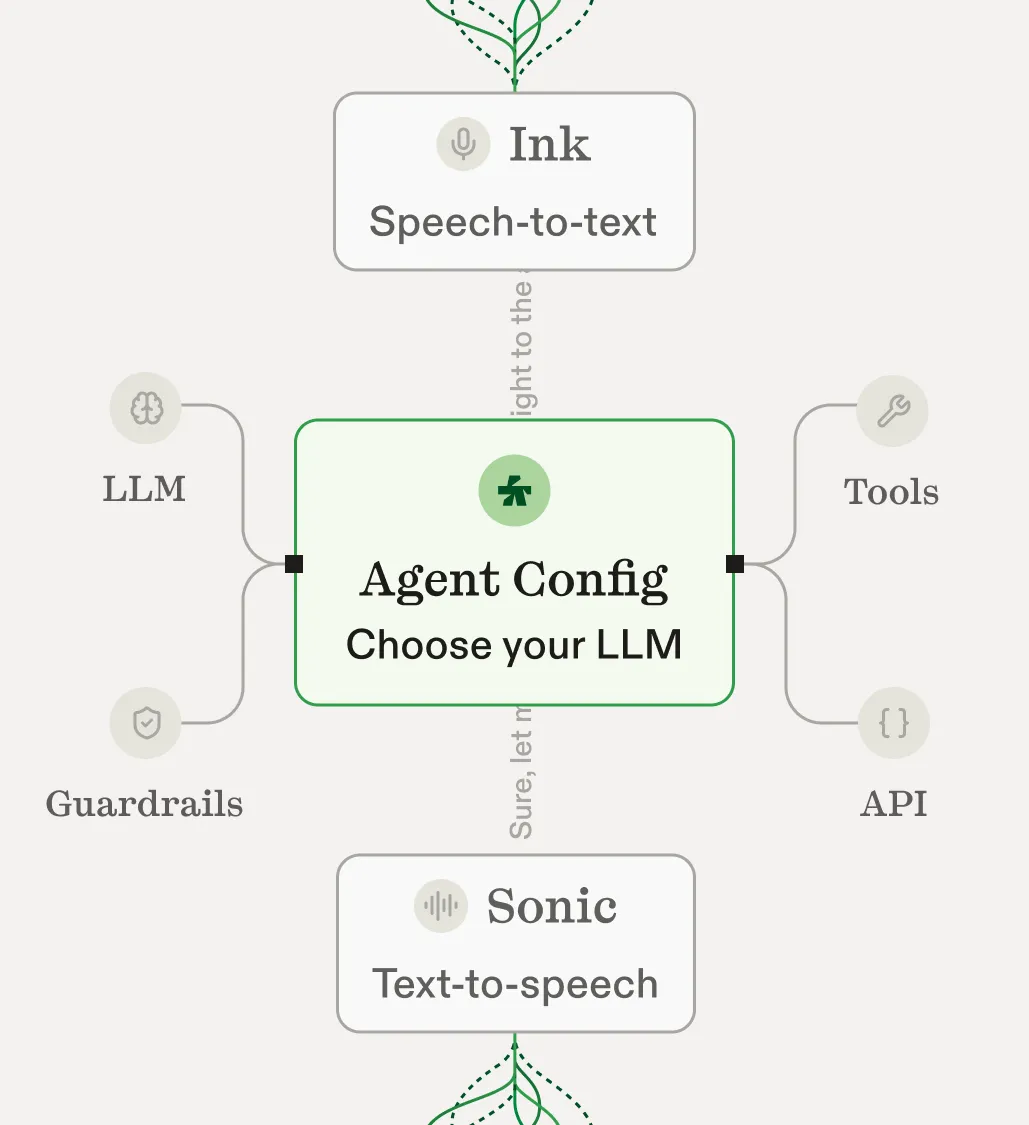
Instructions
Help candidates understand the role and interview process. Share approved information, collect availability, and offer a recruiter callback. Do not score candidates or make hiring decisions.
Speech to text
Ink
Text to speech
Sonic
Connected tools
- get_interview_details
- collect_availability
- request_recruiter_callback
Illustrative conversation
Connect your recruiting and scheduling tools.
Connect your scheduling and applicant-tracking workflows with the permissions they need. Keep evaluation and hiring decisions with your team. Explain to candidates when they are speaking with an automated agent.
Measure the candidate experience, not a voice score
Pilot a coordination workflow such as interview scheduling. Keep candidate assessment separate from the conversation and review whether people can finish the task without repeating information.
Explore Managed Agents and evaluation tools- Scheduling quality: confirm dates, time zones, locations, and rescheduling behavior.
- Candidate choice: test the recruiter callback and alternative communication paths.
- Process accuracy: verify that role details and application status match approved records.
Trusted by leading enterprises. Speaking from experience.
Discover success stories“We didn’t switch to Sonic because it was incrementally better, we switched because nothing else came close… we’ve seen a 2.9% lift in our conversion and a 12.2% increase in customer engagement.”
Akshay Ramaswamy
Staff Product Manager
Enterprise-grade security.From Cloud to Local.

HIPAA compliant

SOC 2 Type 2

GDPR
Recruiting voice AI FAQs
What recruiting tasks can a voice agent support?
Candidate questions, interview coordination, application updates, and information collection are useful starting points. Connect the information and actions each workflow needs.
Does using AI remove hiring bias?
No. A voice model does not establish a fair assessment process. Your team remains responsible for evaluation criteria, accessibility, oversight, and hiring decisions.
Can we connect an applicant-tracking system?
Your implementation can connect the APIs and tools your applicant-tracking system exposes. Scope access to the information needed for the conversation.
Can candidates choose to speak to a recruiter?
Provide a clear callback or handoff path in the workflow. Test it alongside scheduling and status questions before using the agent with candidates.
Can a voice agent schedule interviews?
It can collect availability and use scheduling tools you configure. Check calendar availability, explain the proposed time and time zone, and distinguish a booking request from an interview that has been confirmed.
Should an agent rank candidates by how they sound?
No. The coordination workflows on this page do not require voice-based ranking. Keep hiring criteria and decisions with your recruiting process, and do not infer suitability from an accent, speaking style, or voice.
Can we use voice AI for recruiter training?
You can build practice conversations from representative candidate questions and review the recordings for clarity and pacing. Use fictional or appropriately approved material, and keep training results separate from real candidate evaluation.
What information should we connect from our ATS?
Start with the minimum needed for the task, such as interview details or an approved status update. Define which tools can read or change records, and test what happens when a record is unavailable or access is denied.
More ways to build with Cartesia
Get started today
Talk to an expert.
Connect with a member of our team and learn how Cartesia can help you build world-class voice experiences.
Start building.
Access our models via API and bring a voice agent into production in minutes.